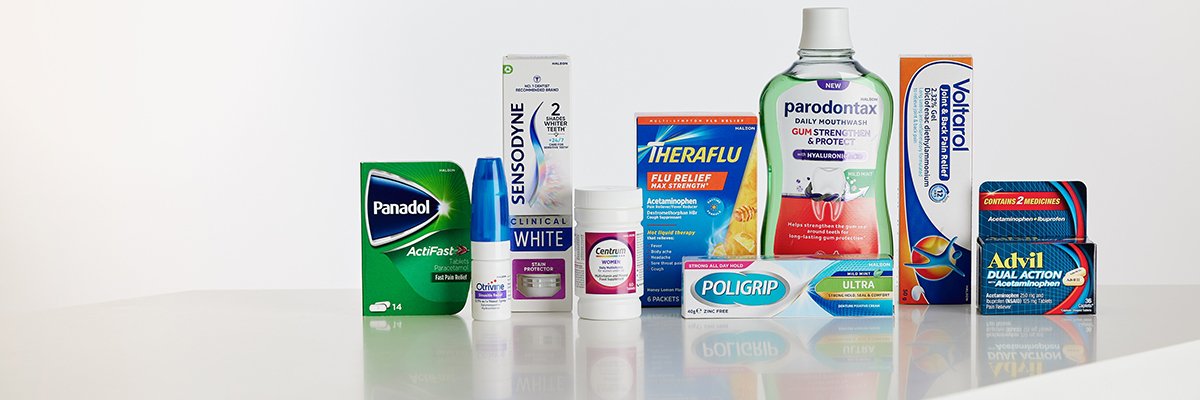
Consumer healthcare company Haleon is both old and new. While many readers might be unfamiliar with the company’s name, they will be familiar with its products. To list them is to recognise the contents of most of our bathroom cabinets: Sensodyne toothpaste, Advil painkillers, Centrum vitamin supplements, Tums and Nicorette, to name but a few.
The company was founded in July 2022 through the merger of consumer healthcare portfolios from GSK, Pfizer and Novartis. Its core enterprise resource planning (ERP) system is a clone of GSK’s SAP ECC6 installation, says chief digital and technology officer Claire Dickson, and the technology strategy plan is to partner with SAP, but also with Microsoft, quite deeply.
Dickson joined Haleon at the time of the new combined company’s inception. She has been guiding a prospective new ERP for the company, S/4Hana on SAP’s Rise cloud migration programme.
Dickson previously held CIO roles at multinational packaging business DS Smith and BP. She was also a senior manager at Accenture and an SAP analyst at United Biscuits. But she says the role at Haleon is of a different order, since it is a whole new company composed of elements drawn from well-established entities. And on the technology side, there is opportunity to put in place a substantially new stack, and one more oriented towards being a consumer company.
“The proposition with Haleon is quite exciting because even though there’s maturity in the company, it’s also brand new,” she told Computer Weekly at this year’s SAP Sapphire conference in Madrid.
The company’s avowed purpose is to “deliver better everyday health with humanity”, focusing on what it describes in its literature as “accessible, science-backed solutions for everyday health needs”. It has annual sales of approximately £11bn (2025) and 24,000 employees. Haleon operates in over 100 markets worldwide. Its stated goal is to reach one billion more consumers by 2030, and it is targeting 4-6% revenue growth annually until then.
Haleon’s SAP board-level contact for its transformation programme is chief executive Christian Klein. He and Haleon’s CEO, Brian McNamara, are closely connected on the partnership. “I would expect that we’ll do some co-innovation together as we get going,” said Dickson.
“When we entered into the partnership with SAP, we made some assumptions that there would be more agentic capability coming, and therefore the partnership was premised on being [SAP] ‘clean core’ and we trust that the agents are coming,” Dickson told Computer Weekly.
“So, we were delighted with the announcement here, because clearly a lot of that comes out of the box as standard,” she added. “Our AI strategy is to leverage as standard out-of-the-box from our suppliers where possible. We don’t want to be systemically building huge numbers of agents ourselves. We are building some, but we don’t want to do that as a strategy.”
“The opportunity here is to design a fit-for-purpose clean core that will enable us to be a much faster-to-market consumer goods company”
Claire Dickson, Haleon
Haleon’s ambitions are big, said Dickson. “The partnership with SAP enables quite a lot of that because the SAP platform that we are on today is basically a clone from GSK. We are in a pharma template now, and we want to be a consumer goods company.
“The opportunity here is to design a fit-for-purpose clean core that will enable us to be a much faster-to-market consumer goods company,” she added.
As part of that, the company has used SAP Signavio, and is planning to use it more. “We’re excited about using Signavio as part of our design process because you can do all your process mining and assessment within SAP. You can lock and load it into the existing ECC platform and see what your process fitness looks like, and based on that process fitness, we can decide where we think the value sits, either through automation or just ripping out some of what we do today,” said Dickson.
“It wouldn’t make any sense to look elsewhere for process mining because it’s just part of the SAP family. Strategically, we are trying to create an ecosystem of partners that’s quite clean. Less is more, I think, and reduces the attack surface,” she added.
When Haleon separated from GSK, it took the opportunity to migrate everything to the cloud. “We put 98% of our kit into [Microsoft] Azure in two years to make us digital ready, which is excellent. And we built on that and signed a partnership with Salesforce to create a pharmacy platform on their Life Sciences cloud,” said Dickson.
“We’re co-innovating [with Salesforce] to build a platform for our salesforce. We have 4,500 salespeople that go out to work with our customers, who are pharmacists, and their healthcare professionals, and also with dentists. So that’s quite a big part of our business, less mass market.”
Collaborating on digital, data and AI
Another supplier that is strategic to Haleon’s transformation is Microsoft.
In June 2026, the consumer health company announced a five-year “collaboration with Microsoft to scale digital, data and AI capabilities across the business”.
The agreement is said to build on Haleon’s existing use of Microsoft 365 Copilot and further supports the wider adoption of AI-powered tools.
In the announcement of that partnership, Dickson said: “This collaboration marks a major step forward in how we use digital, data and AI to deliver our global strategy – driving growth, improving productivity and building a more agile, performance-focused culture.
By combining Microsoft’s cloud and AI capabilities with Haleon’s deep consumer health expertise, we’re accelerating our AI progress – simplifying how we work, unlocking more value from our data, accelerating innovation and helping our teams make faster, smarter decisions to benefit our consumers Claire Dickson, Haleon
“We’re already embedding AI capabilities across the business, delivering measurable results and efficiencies in areas including consumer insights, marketing, R&D and supply chain.
“By combining Microsoft’s cloud and AI capabilities with Haleon’s deep consumer health expertise, we’re accelerating our AI progress – simplifying how we work, unlocking more value from our data, accelerating innovation and helping our teams make faster, smarter decisions to benefit our consumers.”
Alongside these supplier relationships, the company is purposely educating its senior management teams in AI.
“Education is everything,” said Dickson. “As part of our data and AI journey, we are putting all of our top leaders through a Cambridge University data and AI course that we have crafted together.
“Our top 160 leaders will have been through that by the end of September of this year. I think the Cambridge course has been so successful because it’s a two-day course in Cambridge, with leaders flown in from all over the world. We have also deployed a data camp for all employees with differentiated modules for them.
“We have to take accountability for educating our people because otherwise only a minority will use AI properly. Even with Copilot, people don’t tend to use it to its full capability.
“But if you educate people, they realise that, say, at the end of the week you can ask it who owes you an action and what you owe someone else, and get a summary of your last three meetings. But people don’t really know the power of it. They ask it questions more like Google, but that is not the power of Copilot.”