


The ravenous power and cooling requirements of graphics processing units (GPUs) in artificial intelligence (AI) processing are set to make direct-to-chip liquid cooling mandatory.
This is the key factor in the shift away from traditional datacentres and towards AI factories.
It means a significant change in the datacentre landscape that could spell the end of the on-premise datacentre, as both cost and complexity spiral away from the ability of enterprises to build their own.
These are the key takeaways from an event held by datacentre equipment provider Schneider Electric last week, where industry figures discussed the imminent future of the datacentre scene and visited TeraWulf’s under-construction 750MW site on the shores of Lake Ontario.
In this four-part set of articles, we look at the rapid pace of construction at the TeraWulf site, how giant leaps in GPU power dictate datacentre design changes, their effects on the power grid and water use, and colour in the picture as rust belt gives way to AI factory.
The enormous increase in energy consumption driven by AI has brought a step change in datacentre design. Core to this is the requirement to power and cool GPUs to an extent that was not necessary in “traditional” air-cooled datacentres. Hence the advent of the AI factory.
Datacentre cooling has been a predictable exercise in industrial heating, ventilation and air-conditioning (HVAC) design, where one slotted servers into racks and blew chilled air across the chassis. AI has rewritten the story.
The hardware that powers the AI revolution – GPU especially – operates at thermal and electrical densities that render traditional air-cooling methods obsolete. The silicon demands of large language model training and inferencing cannot be sustained by more or faster fans.
Instead, the industry faces an inflection point that mandates direct-to-chip liquid cooling and a transformation of rack-level power delivery to 800-volt direct current (VDC).
Liquid cooling mandatory
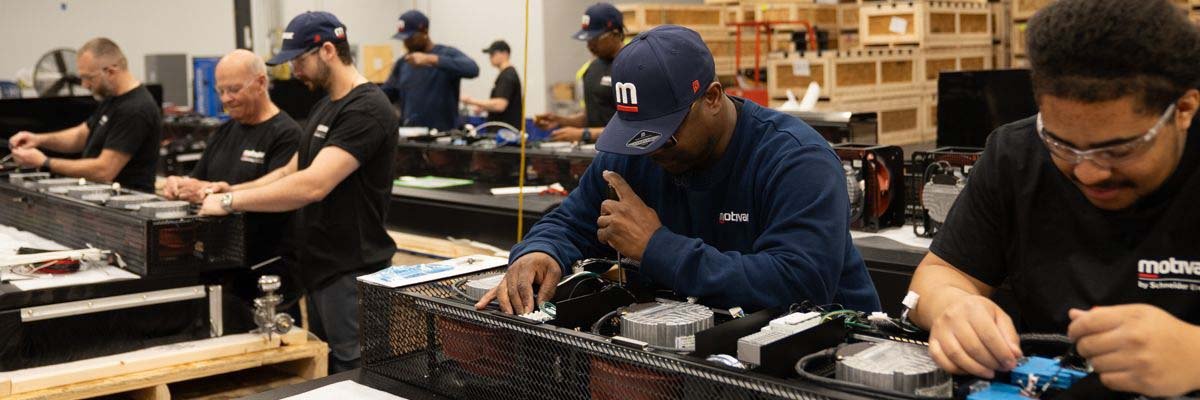
“Liquid cooling isn’t an option, it’s mandatory,” said Rich Whitmore, CEO of Motivair by Schneider Electric, a thermal management firm recently acquired by the latter in 2024 (assembly workers at Motivair pictured above). “It is the baseline for all of these high-voltage processors. The changeover point was at about 700W processors [GPUs] like the H100. That was the crossover point between bending the rules of the laws of physics for air cooling and reality. People simply do not have a choice anymore.”
The physics underpinning the shift are that when a single processor crosses the 700W threshold, air can no longer move fast enough or hold enough thermal energy to prevent the silicon from throttling or melting.
While historical enterprise racks averaged 10kW to 50kW, modern AI training environments routinely deploy 140kW and 150kW clusters. Systems that hit 200kW are set for roll-out, and reference architectures for megawatt-level racks are in place for the end of the decade.
That level of energy concentration converts 100% of electrical input into heat in a footprint the size of a fridge.
Paradoxically, this transition unlocks thermodynamic efficiencies. Traditional datacentres require energy-intensive refrigeration to supply highly chilled air. Liquid cooling systems operate with far warmer fluid temperatures and allow operators to use high-temperature chillers or fluid-to-air dry coolers.
“Air-cooled datacentres are like the old Volkswagen engines where the heat from the load rejects directly into space,” said Tuan Hoang, head of cooling technology and product development at Schneider Electric. “Liquid cooling is like modern automobiles. It is the radiator that removes the heat from the engine. Zero water consumption is actually needed to cool an AI factory when you transition to these closed-loop radiators.”
800V DC the new standard
While thermal limits are bringing fluid dynamics into datacentre white space – the revenue-generating area where IT hardware lives – the current required to drive 200kW to 400kW server configurations would overwhelm existing low-voltage distribution frameworks.
Until now, cloud facilities have relied on Open Compute Project (OCP) standards that deliver alternating current (AC) to the rack and internal power supplies convert it to 48V or 54VDC to supply individual servers. But, as rack densities climb past 200kW, things become mechanically and structurally impossible.
“As you look at trying to use that architecture, you start to run out of headroom,” said Steven Carlini, chief advocate for AI and datacentre at Schneider Electric. “It’s really a mechanical and electrical issue. Right now, you have eight power cables coming into these high-density racks. As you get up towards a megawatt, you would need 32 even larger cables coming into this thing, which is impractical.”
To circumvent this bottleneck, the datacentre design is pivoting decisively towards 800VDC power delivery. More volts equals fewer amps, equals smaller cables. By upgrading the distribution architecture to high-voltage DC, datacentre operators can cut the thickness, weight and complexity of copper feeds entering the cabinet.
This electrical transformation necessitates new designs for power delivery, which can come from a so-called “sidecar architecture” designed for hybrid environments and brownfield retrofits, and takes the power conversion infrastructure out of the primary IT rack and positions it adjacent to compute hardware, or consolidated centralised distribution targeted at greenfield sites where AC-to-DC conversion is upstream at the facility level, distribution bay or end-of-row.
The knock-on effects of changes at silicon level
Re-engineering the datacentre down to the silicon level fundamentally changes how infrastructure is designed and maintained. When compute clusters scale at their current rate, minor electrical anomalies or thermal drops carry catastrophic commercial consequences.
“Datacentres are fundamentally changing,” said Manish Kumar, executive vice-president for secure power and datacenters at Schneider Electric. “We believe datacentres are becoming AI factories of massive scale and complexity. You have to reimagine how you design, build or bring a datacentre to market and think about the datacentre holistically across the full lifecycle.”
This industrial complexity begins with digital twin modelling before physical deployment begins. Because AI developers face large financial penalties for every day GPUs sit idle waiting for power, simulating thermal loads and electrical selectivity in advance derisks capital expenditure and compresses deployment timelines.
Meanwhile, transitioning to an 800VDC framework introduces system protection issues. Unlike AC systems, high-voltage DC circuits lack zero points at which it is easier to break a circuit. This necessitates the development of specialised solid-state circuit breakers so that if a single fault occurs at blade level, only that specific breaker trips and doesn’t take down an entire multimillion-dollar training cluster.
Datacentres are at a crossroads. Operators and enterprise infrastructure face a strategic fork in the road: abandon legacy air and low-voltage electrical power delivery, or potentially face obsolescence as the physical realities of the AI age leave existing infrastructure behind.
Does AI direct-to-chip cooling put paid to on-premise datacentres?
CIOs have existed in a comfortable equilibrium where the corporate data model evolved into a hybrid form. In this, non-critical, elastic workloads migrated to the public cloud, while sensitive core business systems, proprietary datasets and predictable processing loads remained inside corporate walls in traditional air-cooled on-premise server rooms.
AI potentially shatters this model. With the shift from standard central processing unit computing to accelerated GPU clusters, the physical requirements of modern AI hardware cannot work with legacy on-premise designs.
With next-generation silicon demanding mandatory direct-to-chip liquid cooling and unprecedented power densities, is this the end of the on-premise corporate datacentre?
Liquid cooling unviable for the majority?
As we have seen, the root of the infrastructure inflection point lies in the thermal intensity of AI hardware.
For some in the industry, the complexity and capital expenditure required to deploy liquid cooling frameworks means on-premise AI is unviable for the vast majority of enterprises.
In the past, an enterprise could construct a high-quality datacentre building, install the electrical and cooling infrastructure, and reliably run three, four, or even five successive generations of IT hardware refreshes over 15 years without altering the underlying facility.
AI hardware has broken that model. The acceleration of chip design means each consecutive generation of AI processors brings new physical dimensions, power profiles and fluid-flow requirements that are fundamentally incompatible with infrastructure built just a year before.
“In the old days of datacentres, you would build the building and the facility, the power and the cooling systems, and you could do three, four and five IT refreshes,” said Chris Burnett, account executive at Cloudflare. “[With] today’s datacentre … very few people are going to build double the size of the power and the cooling for the next generation. You’re building it for today; it’s extremely challenging.”
For an enterprise CIO, the commercial implications are that constructing an on-premise datacentre capable of handling 200kW racks requires millions of pounds in specialised upfront capital expenditure. If that bespoke facility design becomes obsolete in a single IT lifecycle because the next iteration of silicon requires entirely different fluid dynamics or higher voltages, the financial return on investment evaporates.
Therefore, the argument for outsourcing to massive public cloud hyperscalers or specialised multi-tenant colocation providers becomes compelling.
Or democratic deployment for all?
Others suggest that declaring the death of the corporate datacentre is premature. From this perspective, the long-term future of enterprise AI will not consist solely of monolithic foundational model training – which undeniably belongs in specialised hyperscale environments. Instead, the real commercial value for the average enterprise lies in fine-tuning smaller, highly secure, domain-specific models on proprietary corporate data.
“Will enterprises deploy direct liquid cooling or is that going to stay out of their reach? I think they definitely will,” said Schneider’s Carlini. “They definitely will move to direct-to-chip liquid cooling.”
He said that as direct-to-chip liquid cooling technologies mature, the market will undergo a process of industrial standardisation with infrastructure providers delivering modular, self-contained “plug-and-play” liquid-cooled enclosures designed specifically to fit into existing corporate footprints.
Carlini highlighted that once the initial mechanical barrier is crossed, the inherent thermodynamic efficiencies of liquid systems work in favour of the enterprise. “With the efficiency of liquid cooling and the temperatures you can run at, the water use is much less,” he said.
By operating at significantly warmer fluid temperatures, these systems eliminate the need for massive, complex external refrigeration units, potentially making localised high-density compute more operationally efficient than legacy air systems.
Hybrid probably the key
Meanwhile, there is also the possibility of a hybrid approach structured around the lifecycle phases of AI.
For the resource-intensive training phase – where thousands of GPUs must be tightly clustered together to ingest petabytes of data over weeks or months – the corporate datacentre is definitively unviable. This work will be outsourced to specialised hyperscale or colocation environments that possess the native 800VDC electrical distribution and high-capacity liquid cooling loops.
But once a model is trained, the operational focus shifts entirely to inferencing that requires significantly lower computational density per query and must be located physically close to the company’s operational data stores to minimise network latency and comply with data protection legislation.
This is where the on-premise liquid-cooling services described by Carlini might find their home. In this scenario, enterprise datacentres will be retrofitted to support compact, highly efficient, liquid-cooled inferencing zones.
CIOs should audit their requirements
The advent of direct-to-chip liquid cooling has dissolved the traditional datacentre playbook. The legacy corporate server room cannot adapt to the physics of modern accelerated silicon.
CIOs who try to force AI workloads into traditional air-cooled configurations potentially face thermal throttling, energy waste and ballooning costs. But also, those who attempt to build on-premise replicas of hyperscale datacentres risk capital lock-in on infrastructure that could be obsolete by the next chip generation.
The path forward requires a rigorous, application-driven approach to infrastructure. CIOs should audit their AI application pipelines separately from high-density training needs and localised inferencing.
A hybrid model can leverage the scale of specialised colocation providers for heavy lifting, while preparing their internal teams to adopt standardised, closed-loop liquid systems for secure inferencing.

