


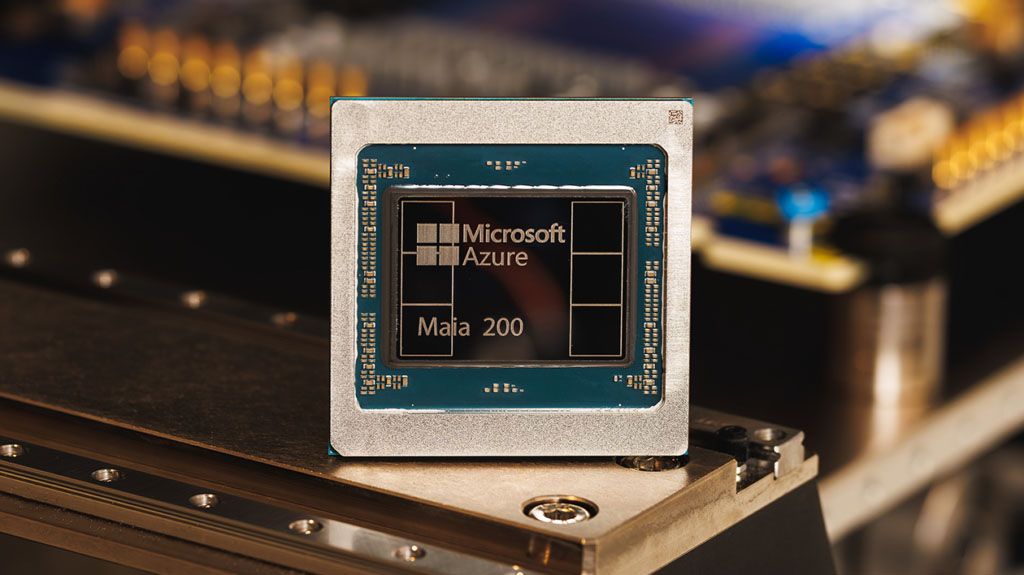
Will Microsoft‘s new AI chip save us all from the AI boom, memory chips worth their weight in gold and, pretty soon, spiraling prices for everything from laptops to phones? Well, no, obviously not. Certainly not on its own. But it might just signal how we do eventually get out of this ridiculous mess.
The big news is that Microsoft has announced Maia 200, its latest in-house chip for running AI models. And it looks potentially very impressive. It’s a massive 140 billion-transistor monster that, by at least some metrics, has the edge on even Nvidia‘s latest Blackwell-generation AI GPUs.
Let’s be clear: Maia 200 is not going to single-handedly solve the ongoing memory supply crisis or usurp Nvidia’s dominant GPUs. It’s not going to prevent PC – and probably phone – prices from going up this year as a consequence of the AI industry’s insatiable demand for GPUs and memory chips and SSDs. Heck, Maia 200 isn’t even for sale to third parties.
A shift away
It seems inevitable, then, that ASICs will eventually replace GPUs for at least running AI models.
Long story short, what Maia 200 does is signal a shift away from using somewhat general-purpose GPUs for running AI in favour of ASICs or Application Specific Integrated Circuits. ASICs are basically computer chips built to do just one very specific task really efficiently. That typically makes them both far more performant and far more cost effective. The obvious example here, handily, also involves GPUs and that’s cryptocurrency mining.
For a time, that too was done on GPUs originally intended for processing graphics. And that too distorted the price of graphics cards. What’s happening with AI, of course, is on a whole different level. It’s going well beyond driving up GPU prices and now threatens to make memory so expensive that consumer devices like laptops and phones become unaffordable.
It seems inevitable, then, that ASICs will eventually replace GPUs for at least running AI models, which is known as inferencing, even if the training of AI models may remain the purview of GPUs for a while longer. The question is when – and chips like Microsoft’s Maia 200 are an attempt to say, “now.”
Yes, Maia 200 is a big, expensive beast with 140 billion transistors. But by some important metrics it shows the advantages of an ASIC over a GPU. It’s said, for instance, to crank out around five petaFLOPS of FP8 performance in return for 750W of power consumption.
That’s about the same in that specific test of AI processing performance as Nvidia’s mightiest B300 AI GPU. But of course B300 actually contains a pair of 104 billion-transistor GPUs and sucks up 1,400W of power. Maia 200 also doesn’t have Nvidia’s massive profit margin added on top.
Of course, there are plenty of factors at play here. Even if Maia 200 does signal a new era of dedicated AI-processing ASICs from a range of competing companies, not just Microsoft, in place of GPUs from a single supplier with an effective monopoly, that doesn’t immediately solve everything.
It might encourage Nvidia to pay more attention to plain old GPUs for gaming. But it wouldn’t solve the supply crisis when it comes to access to the cutting-edge chip manufacturing that’s also needed to make those ASICs, or indeed the memory supply problem. The former involves another near monopoly in the shape of Taiwanese chip foundry TSMC, and the latter won’t be fixed by the likes of Maia, which uses a similar amount of memory as an Nvidia GPU.
Almost certainly, then, 2026 is going to be a mess. PCs, graphics cards, phones, laptops, SSDs — they’re all going to be more expensive.
Assuming the AI boom is long-lasting and not a bubble that’s about to burst, therefore, we’ll also need the likes of Intel and Samsung to up their chip manufacturing games. And the various producers of DRAM and NAND flash memory will need to increase capacity fairly dramatically, too.
But the point about Microsoft’s Maia 200 chip is that it’s a reminder that no matter how intractable the situation currently looks for consumer computing, the market will react. Indeed, it already is reacting. Microsoft won’t pay through the nose for Nvidia GPUs if it can make something cheaper itself. So that’s what it is doing.
Almost certainly, then, 2026 is going to be a mess. PCs, graphics cards, phones, laptops, SSDs — they’re all going to be more expensive. Things will get worse before they get better. But this won’t go on forever, and it could be Maia 200, or something very like it that, in hindsight, ends up being the turning point.
Follow TechRadar on Google News and add us as a preferred source to get our expert news, reviews, and opinion in your feeds. Make sure to click the Follow button!
And of course you can also follow TechRadar on TikTok for news, reviews, unboxings in video form, and get regular updates from us on WhatsApp too.

